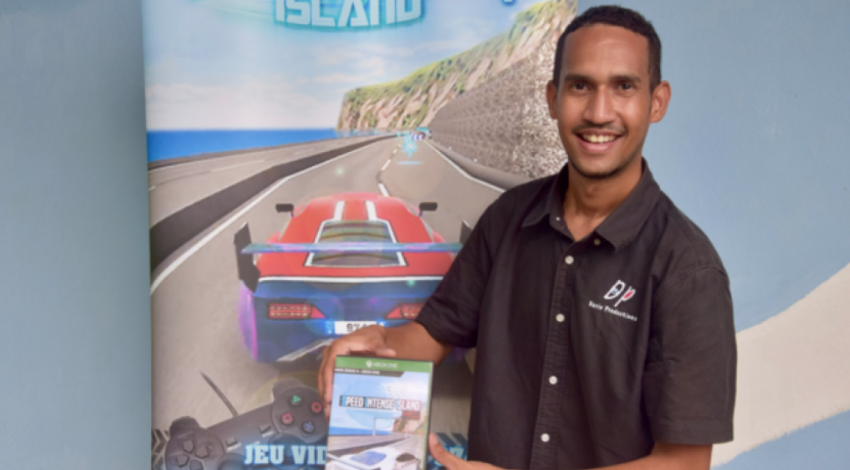
Video Game Developer
14 years of experience in video games
More than 100 video games created
More than 10 million downloads worldwide

Video Game Developer
14 years of experience in video games
More than 100 video games created
More than 10 million downloads worldwide
In the early 2000s, Reunion Island did not yet have a video game industry. The island was rich in creativity, artistic talent, and technology enthusiasts, but no studio had yet attempted to produce a video game with international ambitions.
At that time, the very idea of developing a video game from an island in the heart of the Indian Ocean seemed unrealistic. The industry was concentrated in North America, Europe, and Japan. Major studios had considerable resources, large teams, and direct access to global markets.
And yet, it was precisely in this context that an extraordinary adventure began. In Le Port, a team of enthusiasts decided to take on a huge challenge: to create a video game studio capable of producing an ambitious project from Reunion Island. That studio would be called NP Cube.
NP Cube was founded in 2002 by a group of creators and developers passionate about 3D technologies and virtual worlds.
Its founders included:
These pioneers shared a common vision: to prove that Reunion Island could be a land of technological and artistic creation capable of standing alongside the rest of the world.
The name NP Cube came from the initials of several founders, symbolizing a collective project built around a shared passion.
At that time, everything still had to be invented. There was not yet any local video game ecosystem. Resources were limited, there were no real references, and support structures were almost nonexistent. But the team had one essential asset: ambition.
From the very beginning, NP Cube embarked on an extremely ambitious project: the creation of an MMORPG, a massively multiplayer online role-playing game. The project was named Dark and Light.
For a young studio based in the Indian Ocean, developing an MMORPG represented a gigantic challenge. At the time, only a few experienced international studios had mastered this kind of production. But the NP Cube team was thinking big.
The game promised a vast, open, persistent world in which thousands of players could evolve simultaneously. The universe combined fantasy, exploration, and freedom of play in a gigantic virtual world.
Over the years, Dark and Light attracted the attention of the international video game community. The project stood out for its technological ambitions and for the originality of its geographical origin: an MMORPG developed from an island in the Indian Ocean.
To support the game’s distribution, a publishing structure called Farlan Entertainment was created, based in Mauritius. The project thus became a regional collaboration between several stakeholders.
For several years, the team worked intensely in Reunion Island to bring this universe to life. NP Cube thus became the very first true laboratory of the Reunion video game industry.
But as is often the case in pioneering adventures, the obstacles were many. Creating an MMORPG required considerable technical and financial resources. The project’s complexity, technological challenges, and economic realities gradually made development more difficult.
By the mid-2000s, several difficulties had emerged:
Legal disputes also arose around certain technologies used in the game engine, leading to court proceedings that affected the studio. These events weakened the project’s balance and slowed its progress.
Dark and Light was finally released in 2006. But despite the energy and commitment of the teams, the project did not manage to fulfill all of its initial ambitions. The accumulated difficulties weighed heavily on the future of the studio.
Over the following years, NP Cube’s activity gradually declined. Around 2009, the company officially ceased operations. Thus ended the story of Reunion Island’s first structured video game studio.
Although the NP Cube adventure came to an end, its influence did not disappear. Quite the opposite. NP Cube marked a founding moment in the history of video games in Reunion Island. The studio proved that it was possible to imagine, design, and develop ambitious digital worlds from Reunion Island.
Among the people who took part in this story, Christophe Nazaret and Laurent Paret played an important role in passing on this experience and supporting emerging talents.
Today, a new generation of creators from Reunion Island is developing games, founding studios, and gradually building a real ecosystem.
A story that began in the early 2000s, in a studio based in Le Port, where a handful of enthusiasts decided to attempt the impossible. That story was called NP Cube. And without those pioneers, video games in Reunion Island would probably not be becoming what they are today.

My story with video games began in the days of the Sega Master System, an 8-bit console that marked the end of the 1980s and the beginning of the 1990s. At that time, video games were beginning to enter many homes and open the door to a universe that was still new to many players.
The very first game I ever played was Alex Kidd in Miracle World. This platform game had a special feature: in some versions of the Master System, it was built directly into the console. You simply had to turn the machine on without inserting a cartridge to begin the adventure.
It was with this game that I discovered the pleasure of playing for the very first time.
Later, I discovered Sonic as well as several other major Master System titles. Every new game was a new adventure, a new discovery. Little by little, my passion for video games kept growing.
A few years later, one console would deeply mark my generation: the PlayStation. With it, video games entered a new dimension. Games became more ambitious, worlds became larger, and 3D began transforming the gaming experience.
At that time, I spent long hours playing titles that have since become undeniable classics: Gran Turismo, Tekken, and Metal Gear Solid.
But among all the games I discovered on PlayStation, one of them profoundly changed my vision of video games: Final Fantasy VII.
Until that point, video games had mostly represented moments of pleasure, challenge, and fun for me. But Final Fantasy VII made me discover another dimension: storytelling.
The story, the characters, the emotion, and the depth of the narrative left a deep mark on me. It was no longer just a game. It was an adventure, a story capable of moving players and immersing them in a rich and complex universe.
Then came the PlayStation 2, a console that would push the limits of video games even further and mark an entire generation.
It was during this period that a new form of curiosity appeared within me. I was no longer satisfied with simply playing: I wanted to understand.
I was asking myself many questions:
At that time, all of these questions remained unanswered. But they gave rise within me to something deeper than a simple passion.
Little by little, an idea began to take shape in my mind. Then that idea became an ambition: one day, I wanted to become a video game creator.
When I was still in middle school, I had already understood one important thing: in Reunion Island, there was no school or training program specialized in video game creation.
At that time, my dream of becoming a video game creator seemed very difficult to achieve. Since there was no direct way to pursue that path, I decided to put that dream aside, somewhere in the back of my mind.
After middle school, I chose a vocational high school program in Industrial Equipment Maintenance. This choice had no direct link to video games, but it was the path that was open to me at that moment.
And yet, during my high school years, an unexpected opportunity was about to change everything.
I learned about a training center in Reunion Island that offered education in digital creation and multimedia, with skills that could bring me closer to the world of video games.
I owe this discovery to Mr. Jean Pierre Gallo, an art teacher who taught both at my high school and at ILOI. He was the one who told me about this school and made me realize that this path could exist for me.
That center was called ILOI — the Institut de l’Image de l’Océan Indien (Indian Ocean Institute of Image). For me, it was a true revelation.
For the first time, a concrete opportunity seemed to open up before me. The dream I had set aside suddenly became possible again.
From that moment on, my goal was clear: to earn my high school diploma so that I could continue my studies and try to join that program. I knew it would only be a first step, but it was an essential one.
When I finally joined ILOI, I was determined to learn as much as possible. For four years, I worked hard to acquire as many skills as I could.
In the world of video games, there are many professions, and each discipline plays an essential role in creating a game.
For example:
People often told me that I had to specialize in one precise field. When I was asked, I generally answered that I wanted to become a 3D modeler for video games.
“But deep down, my goal was a little different: I wanted to be versatile.”
I wanted to understand every aspect of creating a video game: character creation, environment modeling, animation, game mechanics design, and everything that makes it possible to bring an interactive universe to life.
My ambition was clear: after leaving ILOI, I wanted to create my own company and work independently, so that I could develop and produce my own video games.
It was an immense challenge, but that dream was also what motivated me to keep learning more and more. During those years, I worked relentlessly. Even outside training hours, I kept learning and practicing at home in order to acquire as many skills as possible.
Every new tool mastered, every new technique learned, brought me a little closer to my goal: one day creating my own video games.
It was at ILOI, the Institut de l’Image de l’Océan Indien, that my path in video games became clearer.
For a long time, I had wanted to create video games. But it was during this period that I began to understand concretely what I had to do to turn that dream into reality.
At that time, I still did not know that this encounter would profoundly shape my journey.
One day, during my very first class devoted to video games, a guest speaker came to meet the students. That man was named Christophe Nazaret.
Even before his involvement in the development of video games in Reunion Island, Christophe Nazaret already had solid experience in the video game industry.
In the early 1990s, he worked as a programmer at Infogrames, one of the major French studios of that era. He notably took part in the development of several games in the famous Alone in the Dark series, now regarded as one of the pioneers of 3D survival horror and an important reference in video game history.
These experiences allowed him to acquire strong technical expertise as well as a deep understanding of video game development.
A few years later, in 1997, he co-founded his own development studio, Gamesquad, thus continuing his career in the video game industry before taking part, in the early 2000s, in the creation of the NP Cube studio in Reunion Island.
After his experience in several studios and his participation in the NP Cube adventure, Christophe Nazaret decided to continue his path in the video game industry by creating his own studio.
That is how he founded the independent studio Dream-Up in 2003. With this studio, he specialized in the development of mobile video games, mainly intended for Android and iOS platforms.
Dream-Up mainly develops arcade games, especially racing games, accessible to a wide audience and distributed internationally on mobile stores.
As our conversations continued, I began to understand that Christophe Nazaret was not simply a speaker or an instructor.
He was one of the pioneers of video games in Reunion Island, having taken part in the NP Cube adventure and in the development of the MMORPG Dark and Light.
But beyond his impressive career, what struck me about him was his vision. He did not speak only about technology. He spoke about creation, strategy, and method.
He explained how to think about a video game project:
These discussions deeply influenced the way I looked at game development.
Over time, Christophe Nazaret became much more than a simple instructor to me. He became a mentor.
I would even say more: in my journey, he was like a second father.
He motivated me, supported me, and encouraged me to pursue my ambitions. He opened doors for me and took me under his wing at a time when I still had so much to learn.
Technical skills are important in video games. But what Christophe Nazaret passed on to me went far beyond that: he gave me a way of thinking about creation.
Christophe Nazaret was not only a game creator. He was also a creator of technologies. He developed a game engine called DreamGame (often abbreviated DG), designed to enable the creation of video games.
Creating a game engine is an extremely complex challenge: it is the tool that makes it possible to bring interactive worlds to life, to manage game logic, interactions, rendering, and many essential systems.
The strength of DreamGame lay in its ease of use and its ability to make it possible to create games quickly.
But like any tool, a game engine does not do everything. The tool is only a means. You still need to know what to do with it.
“I decided to become an expert in DreamGame.”
While classes at ILOI allowed students to gradually discover the engine, I kept working at home, often for hours, to go even further.
I wanted to understand every feature, every possibility, every way of making the most of the engine. I had an immense thirst for learning.
Several elements were aligning at that precise moment:
All of this gave me incredible energy. I worked tirelessly. I experimented, tested, and created.
Looking back, I can say that at that moment, something settled within me: an unwavering determination capable of withstanding every obstacle.
The encounter with DreamGame was incredibly important in my professional career. It was thanks to this tool that I was able to start creating my own games and developing my first experiences.
Thanks to this engine, I was able to create more than 100 mobile video games, downloaded more than 10 million times around the world.
If someone had told me one day that I would achieve that, I probably would never have believed it.
Looking back, I know I will never be able to fully repay everything Christophe Nazaret gave me. He passed on knowledge to me, of course, but above all: a vision, a method, and confidence.
“In a creator’s life, some encounters change everything. For me, meeting Christophe Nazaret is one of them.”
After four years of training at ILOI, the moment finally arrived: I earned my Master’s degree in Video Games. That day, I felt immense happiness.
That diploma represented far more than a simple title. It symbolized years of learning, work, passion, and determination.
I felt deep gratitude:
But at that precise moment, a new stage was beginning: my training was over. The years of learning were giving way to a new reality: the professional world.
“And now… it was my turn to make my move.”
If you would like to discover the video games created by Christophe Nazaret and the Dream Up universe, you can explore them here:
After leaving ILOI, diploma in hand and skills in my pocket, one thing was clear in my mind: I now had to create my own company.
On paper, the idea seemed simple. I knew how to create video games, design projects, and use the tools necessary for development.
But very quickly, I ran into a reality I was not prepared for: administration.
Creating a company meant understanding the procedures, legal statuses, forms, and all the processes required to get started. To be honest, I felt completely lost.
On top of that, there was another difficulty.
Many forms of support intended for young people who wanted to create their own company were denied to me.
The reason was often the same: “Video games are made in mainland France or in Canada… not in Reunion Island.”
At that time, the idea of developing video games from the island still seemed unrealistic to many people.
But for me, that was precisely the goal: to prove that it was possible.
Fortunately, I was not alone. I began with financial help from my parents, which allowed me to take my first steps.
Then I discovered ADIE, an organization that helps people create their own businesses.
Thanks to their guidance and support, I was finally able to officially open my company.
Once I had my SIRET number and the equipment was ready, everything was finally in place.
This time, it was official.
The Darie Productions adventure could begin.
After creating my company, a new adventure truly began: the start of my professional career in video games.
During my training, I practiced by creating small video games. These mini-projects taught me two very important things.
The first difficulty is knowing when to stop. When you develop a game, you can always add something: a new idea, an improvement, an extra detail. But if you are not careful, you fall into a common trap: the game that never ends. At some point, you have to accept saying: the game is finished.
The second important step is publishing. Publishing a game means that the whole world can see it and play it. There will be positive feedback, but also criticism. You should not fear it: negative feedback helps improve the game, and positive feedback gives you motivation to continue.
For a video game creator, publishing your game and facing players’ reactions is an essential step in improving.
My first published video game was called Ambush Zombie. At that time, in 2012, the mobile game market was still relatively young. There were far fewer studios and developers on international stores than there are today.
This situation offered a rare opportunity: it was easier to stand out and find your audience. Ambush Zombie performed fairly well and helped me understand that my plan to make a living from video games could truly become possible.
It was also during this period that I met someone who would matter in my journey: Thierry Brochart, founder of Gamayun Productions. I met him thanks to Christophe Nazaret, who had known him for a long time.
Thierry Brochart has long experience in video game development. As early as the 1980s, he learned programming in BASIC and then in 6502 assembly on Apple II, with help from his older brother. It was during his high school years that he published his first game programmed in assembly. Throughout his career, he notably worked in the Infogrames environment and contributed to several video game projects such as Mystical (1990), Time Commando (1996), and Pretzel Pete (1998).
Very quickly, we began discussing video games, the mobile market, and the different project possibilities. Thierry had great experience in this field and, over time, he became like a second mentor to me.
While I continued developing my own games, we also decided to create mobile games together. The first project we worked on was called XFMX, a freestyle motocross game.
And then… it was a wonderful surprise. The game achieved real success on Android and exceeded one million downloads.
For the first time, I discovered what it really meant to reach one million downloads. This success brought me immense satisfaction and confirmed to me that succeeding in video games was truly possible.
Shortly after, I developed my first racing game: Frantic Race.
This game achieved real success and exceeded 2 million downloads. For an independent developer based in Reunion Island, it was a very important milestone.
It was during 2013 that I met the members of Funky Monkey Studios, another group of video game developers in Reunion Island (also trained at ILOI).
I then continued experimenting with new ideas. I was notably the first to create a racing game with dinosaurs. It too achieved great success, surpassing one million downloads and today approaching 2 million.
Among the games that also marked that period was Bumper Car Destruction, an armed bumper car racing game in which players could battle each other in explosive arenas.
The projects then kept coming. Game after game, I continued creating, experimenting, and publishing new titles.
Little by little, these games allowed me to achieve a very important goal for me: making a living from my work as a video game creator.
Over time, more and more video game developers began appearing in Reunion Island. We then understood that it was important to bring us together.
That is how, in 2014, we created the Bouftang association in order to unite the island’s video game creators.
I am one of the founders of this association.
In Reunion Island, many people started hearing about me around 2015, even though I had already been working in video games since 2012.
It makes sense: at the beginning of my career, I was not developing games specifically linked to Reunion Island. My main goal was first to succeed in making a living from my profession by creating games for the international market.
Once that goal had been achieved, I was able to begin creating games inspired by Reunion Island, intended for the people of Reunion.
It was a great source of pride for me: using my profession as a video game creator to showcase my island and share part of Reunion culture through my creations.
The years went by, and the Darie Productions adventure continued to grow.Today, more than 100 video games have been created and published, mainly on mobile. These games have been downloaded more than 10 million times worldwide.
Several games inspired by Reunion Island have also been created, helping to highlight the island’s culture and identity in the world of video games.
Over time, my work did not remain limited solely to video game development.
Through these actions, my goal remains the same: to show that it is possible to create video games in Reunion Island and to inspire a new generation of creators.
Over the years, some of my games have marked important milestones in the history of video games in Reunion Island.
In 2013, I reached my first one million downloads with my first racing video game, Frantic Race.
In 2015, I developed Speed Intense Island, the first Reunion-made video game to use Reunion Island itself as its setting.
In 2024, I created Street Totochèr, the first fighting game developed in Reunion Island.
In 2025, I took part in the creation of the Pixel Samurai Studio association, of which I am one of the founders.
This adventure brings together several enthusiasts and figures from Réunion Island's geek and artistic culture: Jérôme Payet — Djé San, Yvan Soudy — Staark, Isia Augustine, Sandrine — Mononoke San, as well as myself, Lionel Darie.
The goal is to bring people together around manga, illustration, artistic creation and geek culture in Réunion Island.
In 2025, Street Totochèr reached a new milestone with events played on a giant outdoor screen.
The game was notably played at Le Barachois in Saint-Denis, in front of the public, in an unprecedented format for a Réunion-made video game.
Seeing a game developed in Réunion Island displayed on a giant screen in the heart of the city was a great source of pride for me.
That same year, I created Saint-Paul Dann Tan for the City of Saint-Paul, as part of the European Heritage Days.
Players can discover the traditional occupation of a goat keeper, drive an ox cart, or take an ox to be washed.
Through this project, my goal was to use video games to preserve and pass on some of Réunion Island's traditional occupations and customs.
At the same time, I continued developing games for the international market with the release of Bull Riding Challenge 4.
This new installment offers a more developed western world, with exploration, progression and new activities.
The year 2025 also marked the 10th anniversary of Speed Intense Island, first released in 2015.
To celebrate the occasion, the game received a major evolution with new tracks, new game modes, graphical improvements and updates to several parts of the experience.
Ten years after its creation, Speed Intense Island continues to evolve.
The year 2026 started strong with the release of the first version of Speed Intense Island on Roblox.
For the first time, players can explore environments inspired by Réunion Island together in an online multiplayer experience available on mobile, PC, PlayStation and Xbox.
That same year, Street Totochèr also went beyond the video game itself with the creation of the first T-shirts inspired by its universe.
These products were created in collaboration with the Réunion-based brand Kiltir Kréol, allowing the characters and identity of the game to live on in a new way.
In May 2026, Pixel Samurai took part in the Otaku City Festival 3 at the Cité des Arts, an event bringing together manga, video games, cosplay and pop culture.
With the association, we wanted to create a space with its own strong identity, centered around drawing, manga and Réunion-made video games.
For my part, I fully recreated the Cité des Arts and several surrounding streets in 3D inside Speed Intense Island.
Visitors could drive through this version using a steering wheel and pedals. Seeing people recognize the locations and being amazed by the accuracy of the recreation was an immense satisfaction.
But above all, 2026 marks the beginning of what I consider my ultimate project: MIR - Mémoires Immersives Réunion.
MIR brings together everything I have learned throughout my career: environment modeling with Speed Intense Island, the promotion of Réunion Island's culture with Street Totochèr, and all the skills I have acquired through my many other projects.
The project begins with collecting testimonies from zarboutans, the elders and guardians of Réunion Island's memory. Their memories are then used to recreate places, occupations and moments from old-time Réunion in virtual reality.
Each testimony gives rise to an immersive station, made up of a portrait, objects connected to the story, and a virtual reality experience.
The goal is to reach 10 stations in order to create the complete MIR experience as an immersive and travelling cultural exhibition.
Until then, some individual stations may occasionally be presented in different locations across the island. They will be the first building blocks of the project, but not yet MIR in its complete form.
And my dream goes even further: in fifteen or twenty years, I would like to see the creation of a true immersive museum of Réunion Island's memory, with forty stations or more.
“MIR is the culmination of everything I have learned since creating my first games: using technology to preserve and pass on the memory of Réunion Island.”
Even today, new projects continue to arrive. New games are in development, and the adventure goes on.
I am living my dream. I am living my passion.
Ce métier n’est pas toujours facile. Certains jours sont difficiles, mais malgré les obstacles, créer des jeux vidéo reste pour moi un immense bonheur. "Tiembo largu' pa!"
Over the years, several media outlets have spoken about my journey, my video games, and my projects developed in Reunion Island.
This press review brings together different articles, interviews, reports, and publications about my work and Darie Productions.